Proposals that win, without starting from a blank page
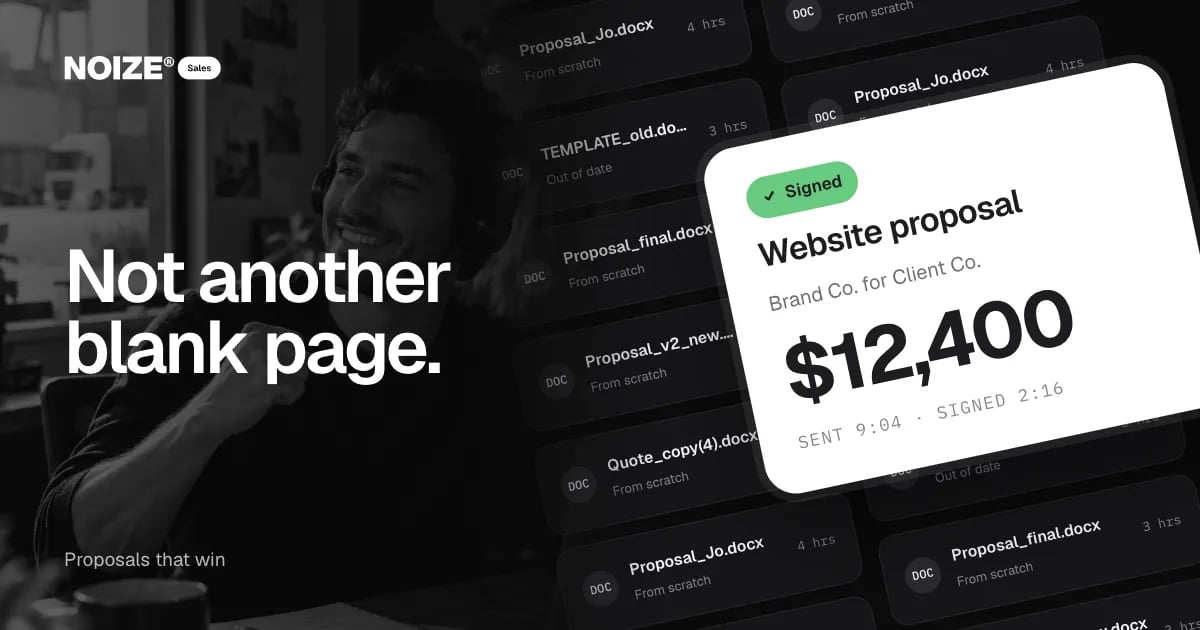
Proposal_final.docx. Proposal_v2_new.docx. Quote_copy(4).docx. Proposal_Jo.docx. TEMPLATE_old.docx. Each took two to four hours. Each looks a little different. Some have the old logo. One quotes last year's prices.
Every proposal starts from a blank page. It is one of the most common hooks we hear from businesses, and one of the easiest to fix. A proposal isn't a creative writing exercise each time. It is a repeatable sales tool that should go out quickly, look like the brand and make it easy for the customer to say yes.
The short version
- A winning proposal restates the customer's problem in their words, sets out a clear plan, shows transparent pricing and asks for one next step.
- It should look like the brand and arrive quickly, ideally the same day.
- Templates, a library of reusable sections and a simple approval process let teams send better proposals in a fraction of the time, which itself improves win rates.
What a winning proposal contains
01Their problem, in their words
Open with what the customer told you. It shows you listened and frames everything that follows.
02The outcome
What will be different for them when the work is done.
03Your plan
The steps, timeline and who is involved, explained simply.
04Proof
A relevant example, short case study or review that shows you have done it before.
05Clear pricing
Transparent costs, options where sensible and what is included. Confusing pricing stalls decisions.
06One next step
How to accept, and what happens immediately after.
Why speed matters
Proposals that arrive the same day signal a business that is organised and keen. Proposals that arrive a week later give competitors time to win and suggest the work might be slow too. Templates make speed possible without sacrificing quality.
Building a proposal system
- Master templates for each main service, on brand and up to date.
- A content library of reusable sections: case studies, team profiles, process descriptions, terms.
- Pricing tables that pull from current price lists.
- Approval rules so proposals over a certain value are checked quickly.
- Tracking so you know when a proposal is opened and can follow up at the right moment.
- Pitch decks for larger opportunities, built from the same brand system.
> I've taken thousands of sales calls and sent hundreds of proposals, and the ones that won weren't the longest. They were the ones that arrived first, said the customer's problem back to them and made the price easy to understand. Everything else was decoration.
“A brand for us to stand behind and be proud of.”
An illustrative example
Picture a web agency writing each proposal from scratch, taking most of a day. A proposal system introduces templates for its three main services, a library of case studies and pricing tables. Proposals now go out within hours of the discovery call, look consistent and are tracked. Win rates improve, and the time saved goes into more sales conversations.
Mistakes to avoid
- Don't make proposals longer to seem thorough. Clarity wins.
- Don't hide the price at the end of a long document. Make it easy to find and understand.
- Don't let templates go stale. Review prices, case studies and branding regularly.
Where Sales and Creative work together
NOIZE Sales designs the proposal structure and sales process. NOIZE Creative makes sure proposals and pitch decks look like the brand. NOIZE Digital can connect proposal tools to the CRM. See sales.noize.com.au.
Questions to ask about your proposals
- How long does a typical proposal take to prepare?
- How many days pass between the conversation and sending it?
- Does it restate the customer's problem in their words?
- Is the price easy to find and understand?
- Does it look like our brand?
- What is the single next step we ask for?
Most proposal problems show up clearly in those answers.
What good looks like
Proposals go out within a day, built from templates for each main service. Each opens with the customer's problem, shows a clear plan, includes relevant proof and presents pricing simply. The next step is obvious. Proposals are tracked so follow-up happens at the right time. Larger opportunities have a short pitch deck built from the same brand system. Win rates are measured and rising.
Proposals as a brand touchpoint
A proposal is often the most important document a prospect reads from your business. It is where the brand, the pricing and the service promise meet. Treating it as a designed, considered piece, rather than a Word document assembled at night, signals the quality of the work to come.
Where to start this week
Gather your last five proposals. Highlight the sections that were nearly identical in each. Those sections are your first template. Time how long the next proposal takes using it.
How Sales connects to the rest of NOIZE
No department works in isolation, least of all this one. NOIZE Talent provides the people to run the process once it exists. NOIZE Legal helps keep terms of trade current, with an appropriately qualified professional where required. And when deals grow larger, NOIZE Accounting helps make sure the pricing still works. Sales stops being one person's job and becomes a system the whole business supports. NOIZE Marketing brings the leads and adjusts campaigns based on which ones close. NOIZE Digital builds the CRM, integrations and automation that keep follow-up running. NOIZE Creative makes proposals and pitch decks look like the brand.
Related reading
- Stop leaving deals on the table: where small businesses lose sales
- Follow-up should not depend on who remembers
Common questions
What should a business proposal include?
The customer's problem, the outcome, your plan, proof, clear pricing and one next step.
How long should a proposal be?
As short as possible while answering the customer's questions. Many winning proposals are only a few pages.
How quickly should I send a proposal?
Ideally the same day or the day after the conversation.
Should I offer pricing options?
Two or three clear options can help customers choose, as long as they are easy to compare.
Do proposal templates make proposals feel generic?
Not if the opening restates the customer's specific problem and the plan is tailored.
What is a pitch deck?
A short presentation used for larger opportunities, showing the problem, solution, proof and price.
Can proposals be tracked?
Many proposal tools show when a proposal is opened, helping time follow-up.
Who designs our proposal templates?
NOIZE Sales and Creative together, so they sell well and look like the brand.
What is sales enablement?
Giving salespeople the tools, content and training they need to sell effectively, such as playbooks, templates and case studies.
How often should the sales pipeline be reviewed?
Weekly for active deals, with a monthly look at conversion rates and trends.
Can NOIZE Sales work with our existing team?
Yes. We build the process and tools around your team and coach them to use it.
What is a qualified lead?
A lead that matches your best-fit customer and has a genuine need, budget and timeframe, as agreed between Marketing and Sales.
How do we know where deals are lost?
Track each deal's stage in a CRM and review lost deals regularly, recording the reason each time.
Your first strategy conversation is on us.
Have a chatThe brand for business.